There's one test that settles most of these arguments, and you can run it from your driveway. Is the gutter failing at a point, or along its length? A blocked outlet, one split joint, a single bracket that has let go — those are point failures, and point failures get repaired. A run that sags in the middle, bleeds rust along its underside, or spills somewhere different after every storm has failed along its length, and no amount of patching brings that back. The rest of this is how to tell the two apart from the ground, before the first winter front.
The 60-second check from the ground
You can get most of the way to an answer without a ladder, and the best time to look is while it is raining. Stand back far enough to see the whole run and work through five things.
1. Where does it overflow?
The most informative observation there is, and almost nobody makes it, because when it is raining hard we are all inside. Spilling at the same corner every time is a blockage, nearly always at the outlet where the gutter feeds the downpipe. Spilling somewhere different each storm, or sheeting over a long stretch of the front edge, means the gutter is silted end to end or has lost its fall.
2. Is there a stain running down the wall below?
A narrow dark tail on the plaster under a joint means that joint has been weeping for a while. A broad discoloured band under a whole span means the gutter has been overtopping along its length. The first is a repair. The second is a conversation.
3. Sight along the line
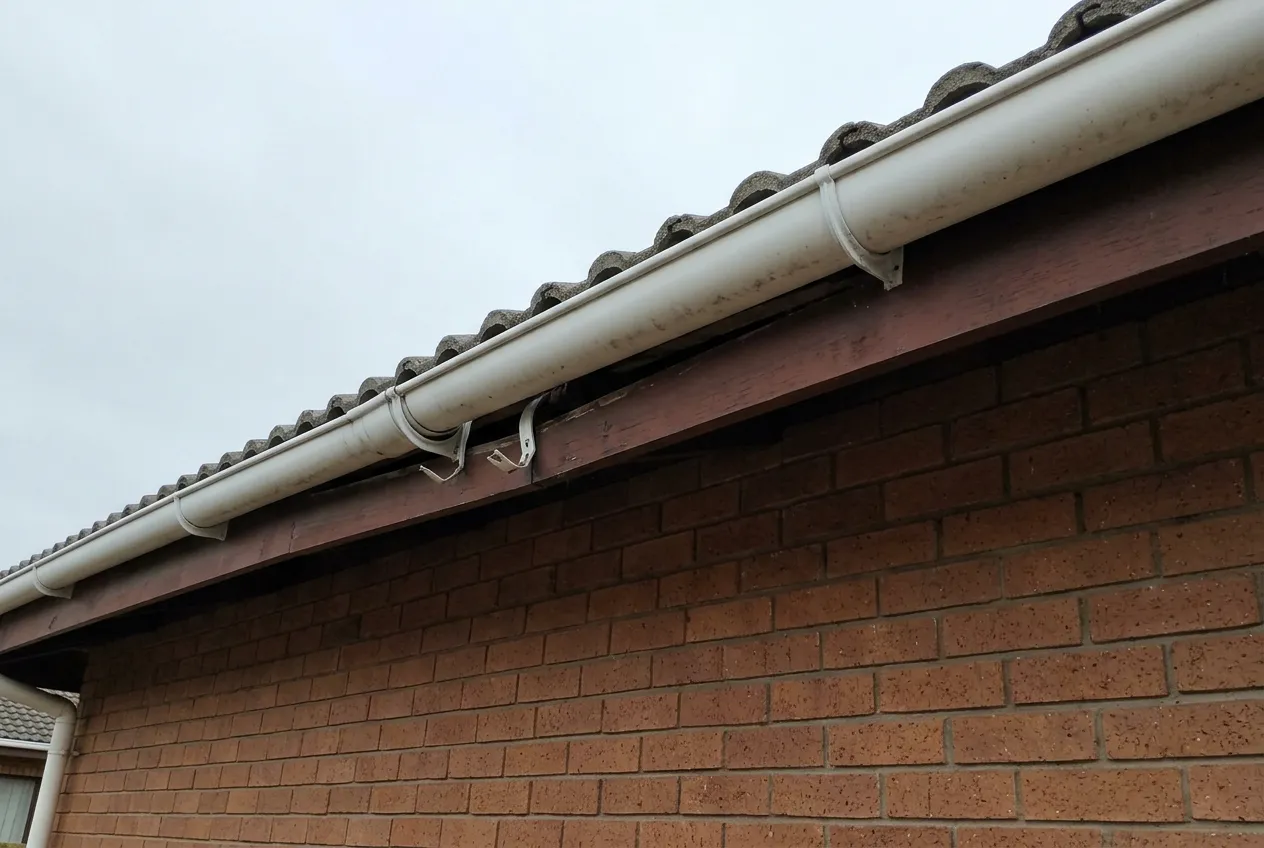
Put your eye close to one end of the run and look along it, using the roof edge as your straight reference. A gutter should read as a clean line sloping gently towards the downpipe. A single dip means the brackets in that span have loosened. A wave across several spans is a different animal.
4. Rust streaks on the gutter itself
Orange bleeding around screw heads, at joints, or on the underside is corrosion working through from the inside, where water sits longest. Surface marking on a straight, sound gutter is cosmetic. Streaking that repeats along the run means its remaining life is measured in seasons.
5. Is anything growing in it?
Grass tufts, moss or a hopeful little seedling above the gutter line means there is enough silt in there to hold soil — and that takes years. Most of what fills a Northern Suburbs gutter starts on the roof above it: oak and pine litter in the older Durbanville and Welgemoed streets, moss off shaded tile roofs from Monte Vista to Kraaifontein. Which is why a roof clean and a gutter clean get booked as one visit — clearing the gutter without dealing with the source just resets the clock.
When a repair is the right call
Plenty of gutters that look bad are fine. If your run ticks most of the points below, repair — or often just a clean — is the honest answer, and anyone telling you otherwise is selling.
- It overflows at one predictable spot. Same corner, every storm. That is a blocked outlet, not a failed gutter.
- One or two joints weep and the rest of the run stays dry. Isolated joint failure is ordinary wear, and it reseals.
- A few brackets are loose but the fascia behind them is hard. If the timber still holds a screw, the gutter can be re-hung and re-levelled.
- The gutter is straight and unperforated. No pinholes, no soft rusted patches, no splits along its length.
- The problem is downstream. A blocked downpipe, or a discharge that dumps water against the wall instead of away from it, has nothing to do with the gutter above it.
- Sag is confined to one span. Localised is fixable.
- It is simply full. More Northern Suburbs gutter complaints are solved by a proper clean than by any repair.
When you are throwing money at a gutter that needs replacing
The counter-list. If several of these are true, further repairs are a slow way of paying for a replacement you will buy anyway.
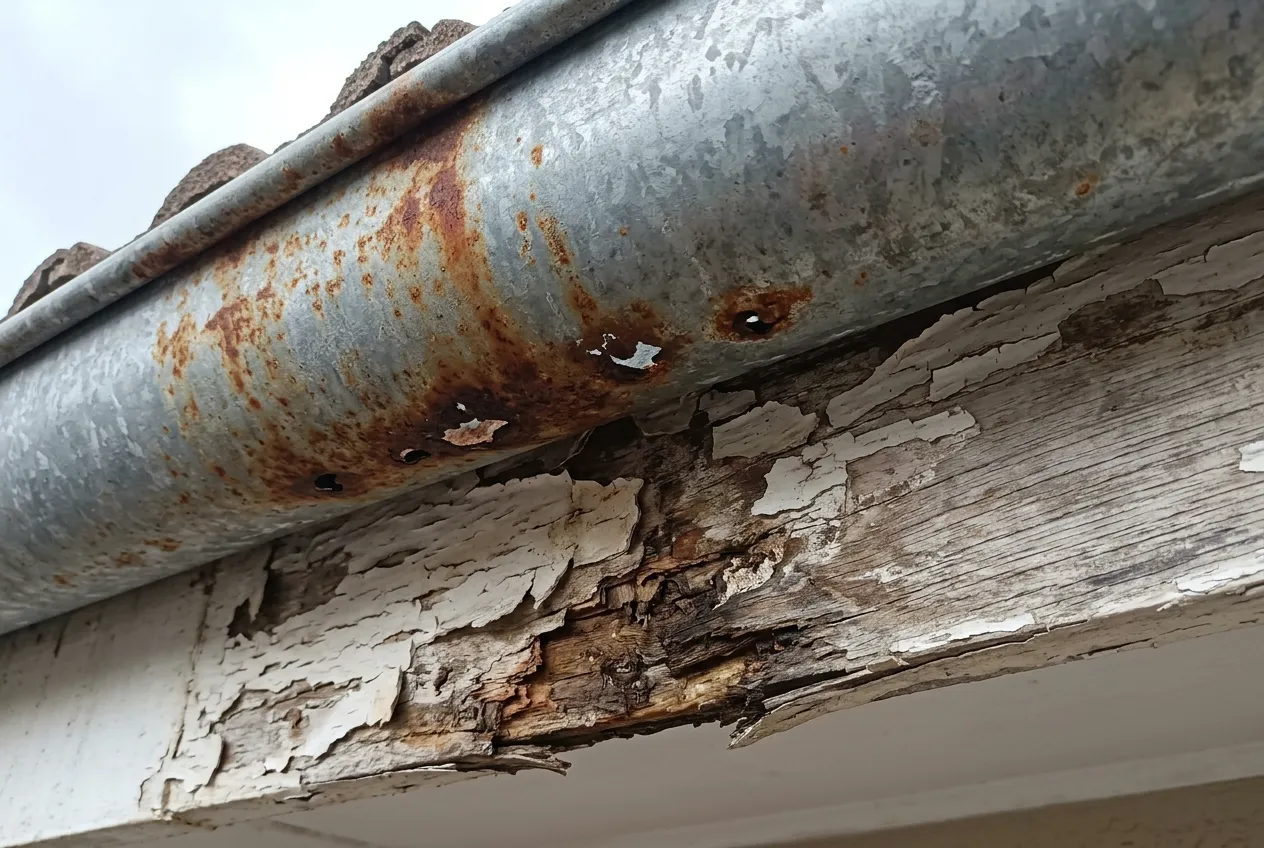
- Rust perforation in more than one place. Corrosion does not stay put. Patch one hole and the next opens a metre away.
- The line waves across several spans. Multiple failed brackets is a symptom of what they are screwed into, not of the gutter.
- Water stands in it after days of dry weather. The fall is gone, and you cannot seal your way back to a correct slope.
- The fascia is soft along a length of the run. New brackets in rotten timber pull out again, usually during the first serious front.
- Third callout in two winters. The pattern tells you more than any single fault does.
- It is visibly undersized. Water sheeting past the front edge of a clean, correctly hung gutter means the profile is too small for the roof feeding it. This turns up constantly on extensions in Brackenfell and Stellenberg, where an added room was roofed into a run never sized for the extra catchment.
- It is an old sectional gutter with a joint every few metres. Every joint is a future leak, and they tend to go together.
The uncomfortable arithmetic deserves stating plainly. Spot repairs run R180 to R400 per linear metre, depending on access and joint count. Full seamless aluminium replacement runs R250 to R550 per linear metre installed, brackets, outlets and downpipes included. Those two bands overlap. Repair the same stretch twice and you have spent replacement money — and you still own the old gutter.
Symptom, likely cause, verdict
A starting point rather than a diagnosis — the same symptom can have two causes, and access changes the answer. One clarification first: if water is showing up on a ceiling rather than running down an outside wall, gutters are probably not your problem, and our page on tracing and fixing roof leaks is the better place to begin.
| What you see | Likely cause | Repair or replace |
|---|---|---|
| Overflows at the same corner every storm | Blocked outlet where the gutter meets the downpipe | Repair — often just a clean |
| Spills over a long stretch of the front edge | Silted end to end, or fall lost through sagging | Clean first; replace if the line stays wrong |
| One visible dip in the gutter line | Brackets in that span have worked loose | Repair — re-hang and re-level that span |
| Wavy line across several spans | Brackets pulling out of failing fascia | Replace gutter and fascia together |
| Orange streaks at screw heads and underside | Corrosion working through the metal | Replace the affected run |
| Narrow dark stain on the wall under one joint | Failed joint seal | Repair |
| Grass or seedlings growing in the gutter | Years of silt, often with a fall problem underneath | Clean, then re-check the fall |
| Clean gutter, but water sheets past it in heavy rain | Profile undersized for the roof feeding it | Replace with a larger profile |
| Fascia soft or spongy behind the gutter | Long-term overflow rotting the timber from behind | Replace both — the gutter alone will fail again |
Gutters and fascia are one job
This is the part most quotes skip, and it is why so many replacements disappoint. A gutter does not hang from the roof — it hangs from brackets screwed into the fascia board, the timber running along the eaves. Everything depends on that timber holding a screw.
The failure loop is depressingly tidy. The gutter overflows, water runs down behind it, the back of the fascia stays wet for months through winter, and the timber softens. Soft timber loses its grip on the bracket screws, so the gutter drops. A dropped gutter holds water where it should be draining, so it overflows more readily, so the fascia gets wetter. The two fail together because each was causing the other.
That is why quoting the gutter alone is a false economy. New seamless aluminium screwed into rotting timber sags on the same schedule the old one did, and the guarantee will not help, because the gutter is not what failed. So the question worth asking is: what happens if the fascia turns out to be rotten once the old gutter comes off? A specialist will already have an answer — they will have pressed a screwdriver into the board before quoting. It runs the other way too: not every job needs new boards, and you should not pay for them because including them was easier than checking.
What about EPDM and patch products?
EPDM is a synthetic rubber. In gutters it turns up as self-adhesive tape pressed onto a cleaned surface, and as brush-on liquid rubber that cures into a flexible film lining the gutter. Both are genuinely useful and both get badly misused.
EPDM earns its keep on a gutter that is fundamentally sound and has one identifiable defect. A single split. One joint that has opened. A perished seal around an outlet while everything either side is fine. You are bridging a small, known gap in an otherwise healthy run, which is what the material is for. It is also a fair way to hold a leak through a wet season when replacement is already booked for spring.
It becomes a bodge when it is used to hide a condition rather than fix a defect. Lining a corroded gutter with rubber does not stop the corrosion — it puts a skin over metal still rusting underneath, and the patch lets go at its edges. Applying it to a run with the wrong fall makes that run watertight and it will still overflow, because the water was never escaping through the gutter, it was going over the top. These are bonded products too, so they need a clean, sound, dry surface to grip — and a gutter in mid-winter is rarely any of the three, which is exactly when people reach for the tape.
The honest rule: EPDM fixes holes. It does not fix geometry, and it does not fix rust.
What it costs
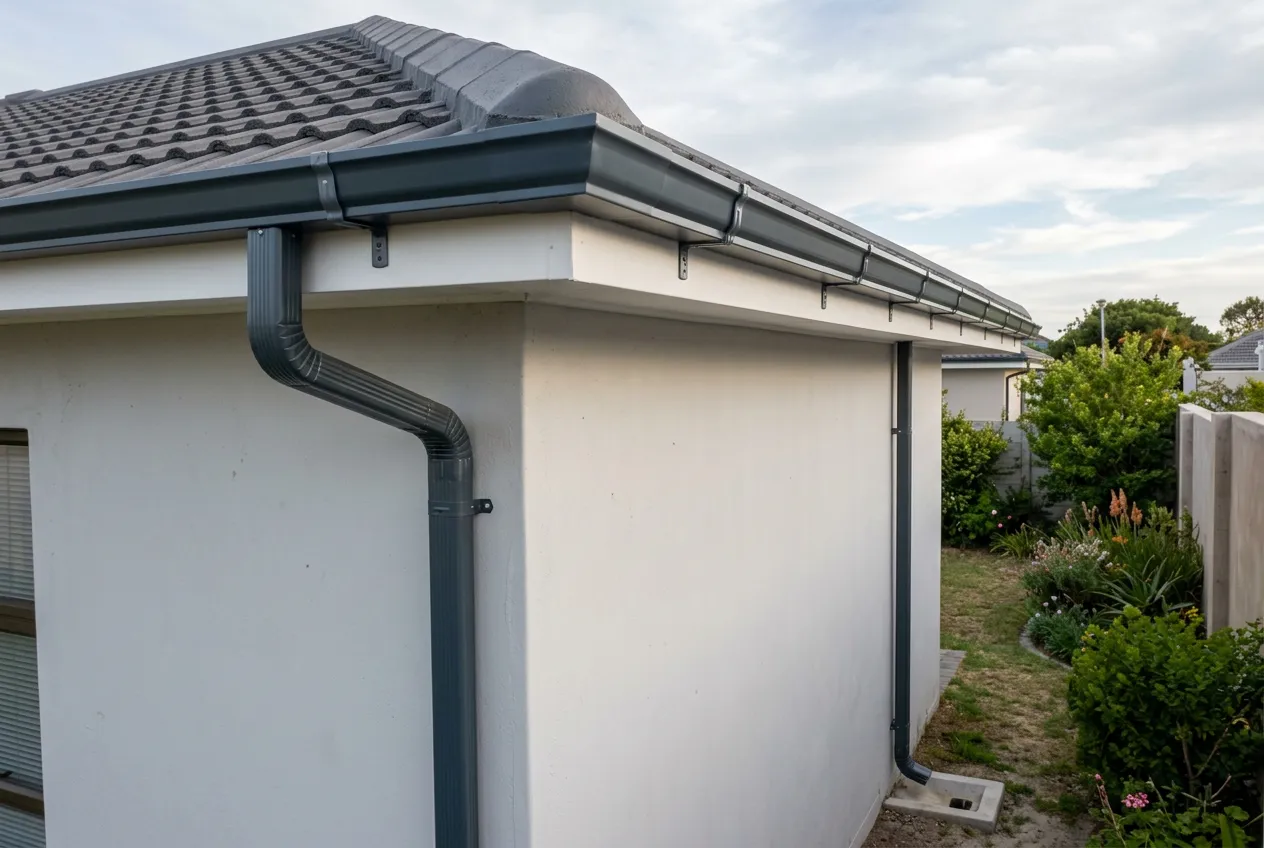
These are the indicative ranges we work to. Access, roof height and joint count move the number more than anything else, and the figure that matters comes from someone standing in your garden looking at the run.
- Cleaning: R450 to R900 for a single-storey home. R900 to R1,500 for a double-storey or a larger home.
- Spot repairs: R180 to R400 per linear metre, depending on access and joint count.
- Full seamless aluminium replacement: R250 to R550 per linear metre installed, including brackets, outlets and downpipes. It varies with profile, colour and roof height.
- Leaf-guards: R80 to R150 per linear metre installed.
Worth noticing what that first line means. A clean is the cheapest thing on the list and it is the complete answer for a large share of the gutters people call about. If someone clears the run and tells you the gutter is fine, that is a good outcome, not a wasted callout. What is included at each level sits on our gutter repair and cleaning page.
Why this matters before winter
The Cape runs on winter rainfall. The cold fronts arrive roughly May through August, one after another, and they do not wait for a dry week so someone can work on your eaves. That compresses the useful repair window into the months before them, which is where we are now.
What matters is not the water you can see — it is where it goes. An overflowing gutter is not dropping water into the garden where the downpipe would have put it. It is pouring it down the external wall, onto the same patch of brickwork, front after front, for four months, and the wall never dries out between storms. Then in July somebody notices a damp patch inside that wall and starts pricing damp treatment for a problem a gutter clean would have prevented.
So if a damp patch appears reliably in winter and fades over summer, look outside before assuming the worst — our guide to telling rising damp apart from the conditions it gets confused with covers how to read the difference. The two call for completely different work, and one is a great deal cheaper to sort out.
The bottom line
Back to the one test: point failure or line failure. If your gutter is letting go at a specific, identifiable place and the rest of the run is straight, sound and hanging off solid timber, repair it and get on with your life. If it waves, holds standing water, bleeds rust in several places, or you have already paid someone to fix it twice, stop — you are financing a replacement in instalments with nothing to show for it.
And if the answer is that nothing is wrong, that is a fine answer too. Plenty of gutters across Durbanville, Bellville, Plattekloof and Edgemead need a clean before winter and nothing more.
If you would rather have someone read the run properly, send through a quote request and a vetted Northern Suburbs specialist will come out, look at the gutter and the fascia together, and tell you which of the two conversations you are having.
What is your gutter likely to cost?
Built on the same rates published on our gutter service page. It is a sanity-check range, not a quote — the real number comes off a ladder.
Right call on a sound run with a handful of failure points.
Pace it out along the eaves. A typical single-storey Durbanville home runs roughly 20–35 m of gutter in total.
Indicative range
R4 320 – R9 600
Excluding VAT
Excludes fascia board replacement, which is quoted separately once the boards behind the brackets have actually been looked at. If the run needs three or more spot repairs along its length, compare the repair figure against the replacement figure before you commit — that comparison is usually the whole decision.
Need a free on-site quote?
Up to 3 vetted Durbanville waterproofing specialists will contact you within 24 hours to book a free no-obligation inspection.
Frequently asked questions
Is it cheaper to repair or replace gutters?+
Repair is cheaper once. It stops being cheaper when you do it twice. Spot repairs run R180 to R400 per linear metre depending on access and joint count, while full seamless aluminium replacement runs R250 to R550 per linear metre installed, including brackets, outlets and downpipes. Those bands overlap, so repairing the same stretch a second time means you have spent replacement money and still own the old gutter. Repair a point failure; replace a run that is failing along its length.
Can you repair a rusted gutter?+
A single rusted spot on a gutter that is otherwise straight and sound can be repaired. Rust appearing in several places along the same run is different, because corrosion does not stay where you found it. Patching one hole in a rusting gutter typically buys a season before the next one opens nearby. Sealants and rubber patches also bond poorly to actively corroding metal, so the repair tends to fail at its edges. If rust is showing at intervals along the run, replacement is the more honest call.
Do I need to replace the fascia when I replace the gutter?+
Only if the timber has gone soft, but check rather than assume. Gutter brackets screw into the fascia board, so a rotted board cannot hold a new gutter level and the replacement will sag on the same schedule the old one did. Long-term overflow rots fascia from behind, which is why the two so often fail together. Ask any contractor quoting a replacement what happens if the fascia turns out to be rotten once the old gutter comes off. A sound board should not be replaced just because it was convenient to include it.
How much does gutter replacement cost per metre?+
Full seamless aluminium replacement runs R250 to R550 per linear metre installed. That includes the brackets, outlets and downpipes, so it is a complete figure rather than a materials-only rate. Where you land in the band depends on the profile, the colour and the roof height, since working at double-storey eaves costs more than working off a low single-storey edge. Treat it as indicative until someone has measured the actual run and looked at the access.
Does EPDM gutter repair tape actually work?+
On the right problem, yes. EPDM is a synthetic rubber sold as self-adhesive tape or as a brush-on liquid that cures into a flexible film, and it is a legitimate fix for an isolated split, an opened joint, or a perished seal around an outlet on a run that is otherwise healthy. It is also a reasonable way to hold a leak through a wet season when replacement is already booked. What it cannot do is fix a corroded gutter or one with the wrong fall, and it needs a clean, dry, sound surface to bond to.
How much does gutter cleaning cost in Durbanville?+
R450 to R900 for a single-storey home, and R900 to R1,500 for a double-storey or a larger home. It is the cheapest item on the list and it is the complete answer more often than people expect, because a great many gutter complaints are silt rather than damage. If a specialist clears the run and tells you the gutter itself is fine, that is a good result. Clearing the roof of moss and leaf litter at the same time slows down how quickly the gutter fills again.